
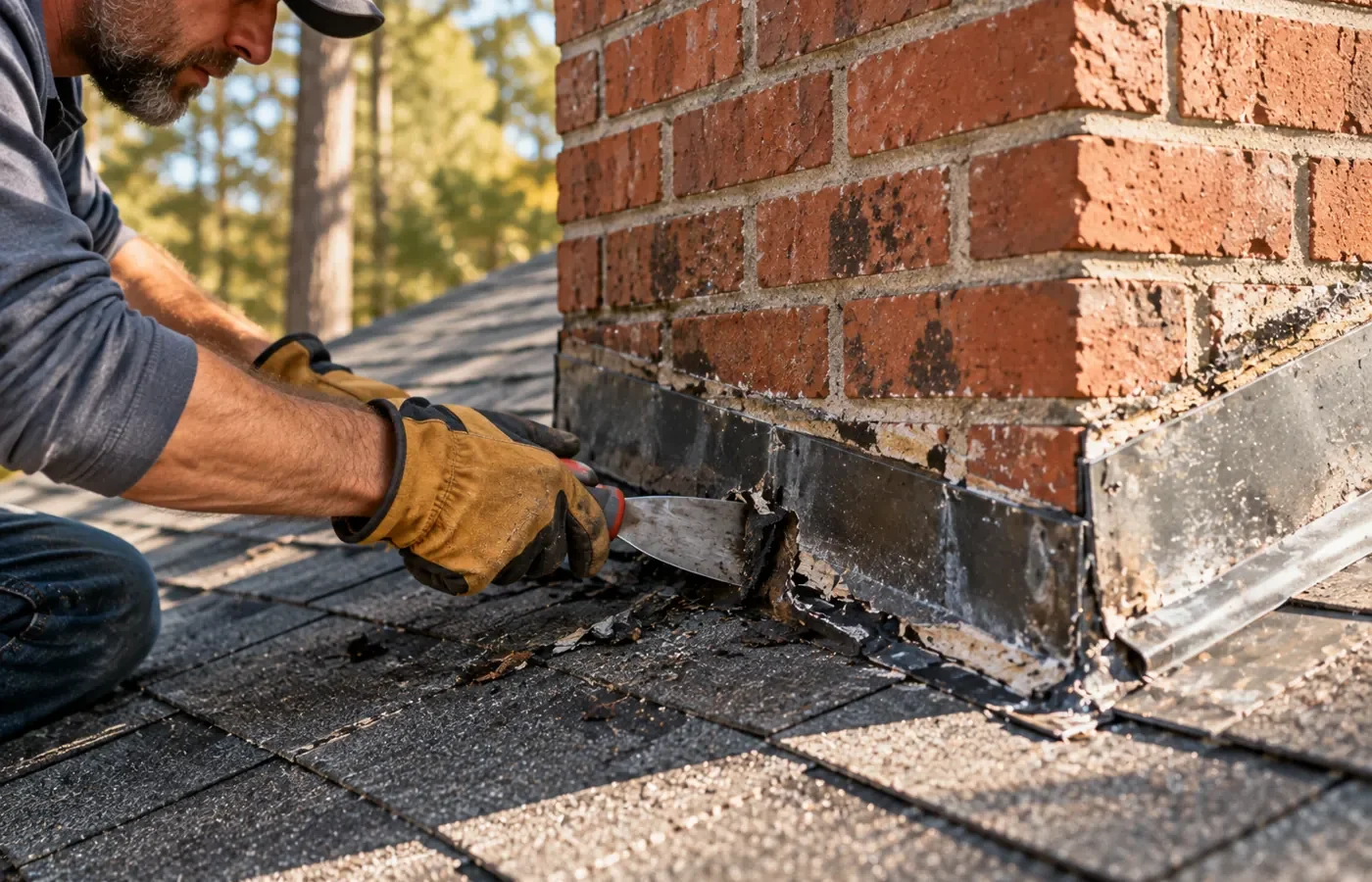
Most roof leaks around a chimney come from the flashing where the roof meets the brick: rusted step flashing, counter flashing that has pulled away, or caulk and tar that cracked. Other causes are a missing cricket behind a wide chimney, a cracked concrete crown on top, or a missing rain cap that lets water into the flue.
The five places chimneys leak
| Where | What fails | Clue |
|---|---|---|
| Sides | Step flashing | Water on the side walls of the chimney chase in the attic |
| Brick face | Counter flashing, caulk | Caulk line pulled away from the brick |
| Uphill side | No cricket, debris | Leaves and needles piled behind the chimney |
| Top | Cracked crown | Water inside the chimney, damp brick indoors |
| Flue | Missing cap | Water in the firebox |
Why chimney leaks are so common on older homes
The median home in Pine Bluff was built in 1972 (US Census ACS 2024), and many of those brick ranches still have the original chimney flashing, or flashing that was tarred over during a later reroof. Caulk and tar crack after a few summers in the Arkansas sun, and every hard rain after that finds its way in.
Is it the chimney or the roof?
Check the attic during rain. If the wet wood is on the framing around the chimney chase or the decking touching it, the chimney flashing is the likely cause. If water appears inside the chimney itself, the crown or cap is more likely.
How it gets fixed
Flashing leaks are fixed by replacing step flashing under the shingles and setting new counter flashing into a mortar joint cut in the brick. A cricket is added behind wide chimneys. Crown and brick problems are mason work. See chimney leak repair and chimney leak repair cost.
Can I seal it myself for now?
A bead of roofing sealant where the counter flashing meets the brick can slow a leak for a short time. It is a temporary patch, not a repair. See is caulk a permanent roof fix.
Why does my chimney leak only in heavy rain?
Heavy rain piles water against the uphill side of the chimney and wind pushes it into the flashing seams. A small gap that stays dry in light rain lets water through when that happens.
What is counter flashing?
Step flashing is the L-shaped metal woven in with the shingles along the sides of the chimney. Counter flashing is the second layer, set into a mortar joint in the brick and bent down over the step flashing. Together they let the roof and the chimney move separately without opening a gap. When a roofer skips the counter flashing and glues metal to the brick face with caulk, it usually leaks within a few years.
Signs of a chimney leak inside the house
- Stains on the ceiling or wall next to the fireplace
- Peeling paint or damp drywall around the chimney chase
- Water or rust stains in the firebox or on the damper
- A musty smell from the fireplace after rain
Do all older chimneys need new flashing?
Not all. If the flashing is metal set into the mortar joints and there are no signs of water in the attic, it may have years left. We look and tell you honestly, with photos either way.
How do I know if my chimney flashing is bad?
Look for rust, gaps, caulk pulled away from the brick, or tar smeared along the base, and wet wood around the chimney in the attic.
Can a chimney leak cause a ceiling stain far from the fireplace?
Yes. Water can travel along the framing before it drips.
Does a chimney need a cricket?
Chimneys wider than 30 inches along the roof slope should have one to divert water around them.
Is a chimney leak covered by insurance?
Usually only if a storm or falling limb caused the damage.