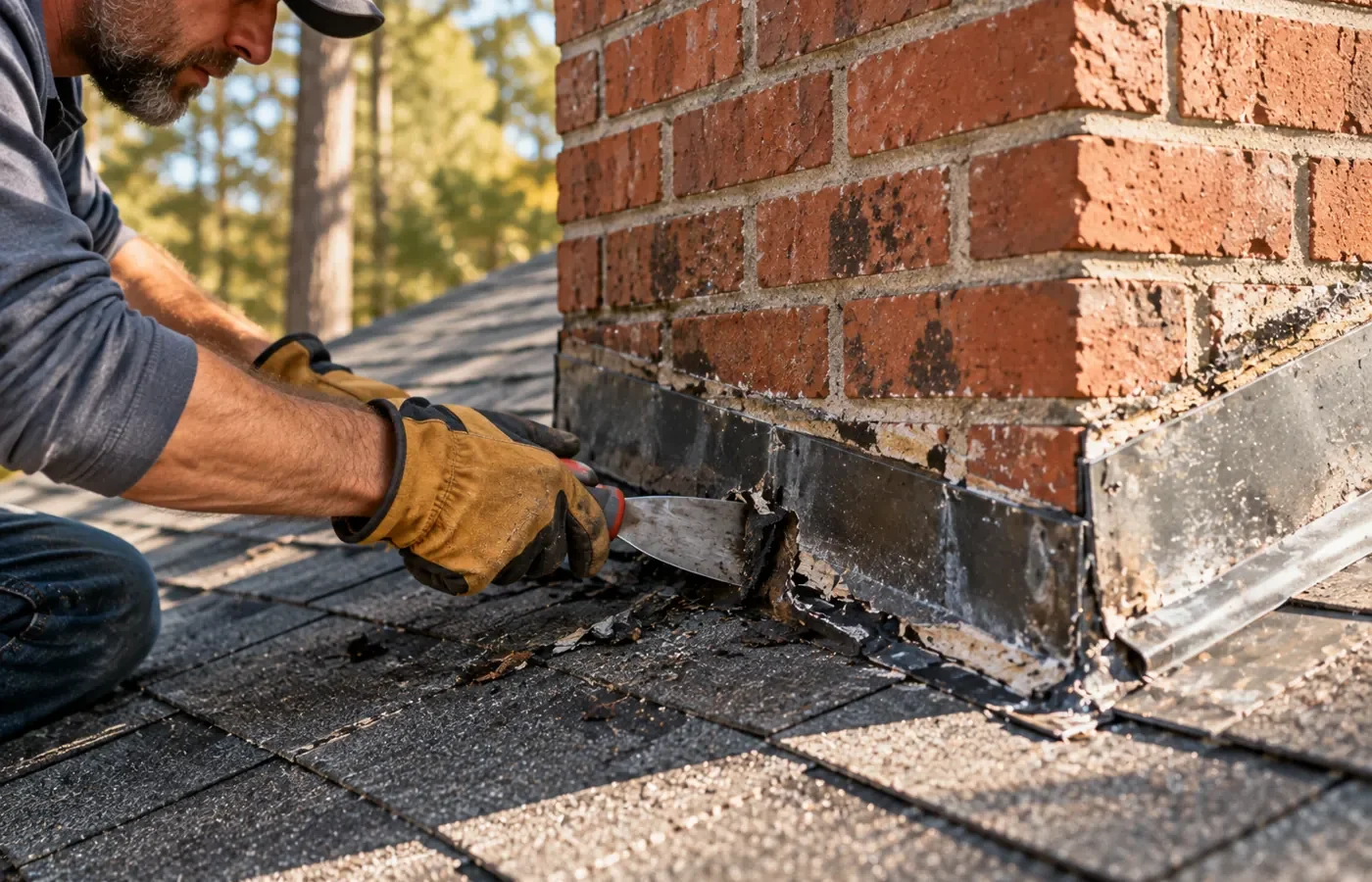
Most chimney leaks in Pine Bluff come from the flashing where the roof meets the brick, not from the brick itself. Old caulk and tar crack, water slips behind the metal and runs down the chimney into your ceiling. We find the exact gap, replace or reseal the flashing, and text you the before and after photos.
A stain on the ceiling next to the fireplace after a hard rain is one of the most common calls we get in Pine Bluff. That makes sense here. The median home in town was built in 1972, and about two out of three homes are older than 1980 (US Census ACS 2024). Many of those are brick ranches with a brick chimney, and the metal flashing around that chimney is often the original piece, or a patch of roofing tar from years ago.
The good news: a chimney leak is usually a small repair, not a new roof. Jacob checks the attic first, confirms the gap on the roof, and gives you a written price before any work starts.
Signs your chimney is leaking
- A brown stain on the ceiling or wall right beside the fireplace or chimney
- Water on the hearth or inside the firebox after heavy rain
- Dark, soft or moldy wood around the chimney when you look in the attic
- Cracked caulk, roofing tar or silicone smeared along the base of the chimney
- Peeling paint or white crusty stains (efflorescence) on the brick inside the house
- A musty smell near the fireplace a day or two after a storm
If the stain only grows during hard, wind-driven rain and stays dry in a drizzle, that points to flashing. Our guide on why a roof leaks only in heavy rain explains why.
Where chimney leaks actually start
Water can get in at five different places around a chimney. Knowing which one matters, because each needs a different fix.
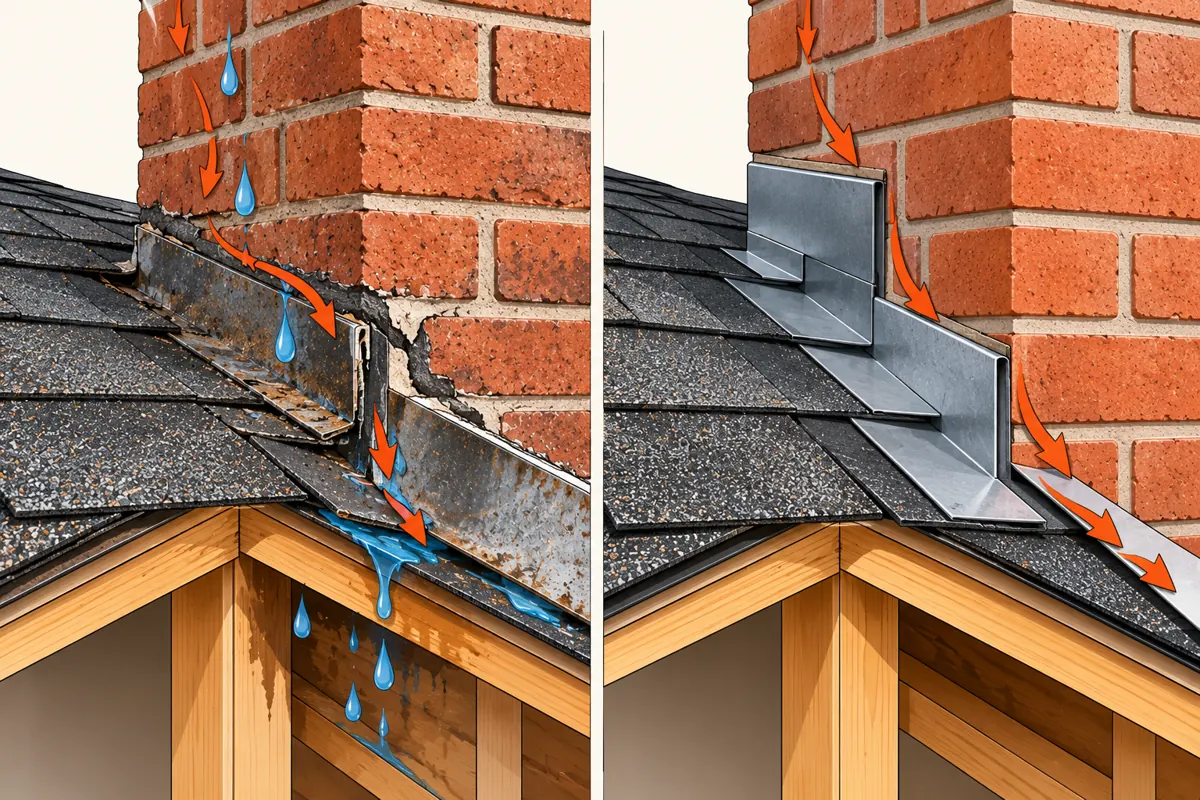
1. Step flashing along the sides
Step flashing is a row of small L-shaped metal pieces woven under each course of shingles up both sides of the chimney. When a piece rusts through, slips or was never installed, water runs along the brick and straight under the shingles.
2. Counter flashing on the brick
Counter flashing is the metal that covers the top edge of the step flashing. Done right, it is cut into a mortar joint in the brick. On many older Pine Bluff homes it is just glued to the face of the brick with caulk. That caulk dries out in the Arkansas sun and pulls away, and every rain after that goes behind it.
3. The back of the chimney (cricket)
The uphill side of a chimney catches all the water running down the roof above it. A wide chimney needs a small peaked cricket (also called a saddle) behind it to split that water around the sides. The residential building code calls for one on chimneys wider than 30 inches. Without it, leaves and pine needles pile up behind the chimney and water sits against the flashing.
4. The chimney crown and cap
The concrete crown on top of the chimney cracks over time, and freeze-thaw nights (Pine Bluff averages about 24 of them a year) widen those cracks. Water then soaks down through the chimney itself. A missing rain cap lets water straight into the flue.
5. Metal flue pipes
Homes with a prefab fireplace have a metal flue pipe through the roof instead of a brick chimney. Those leak at the storm collar and the boot around the pipe, which is closer to a vent pipe leak than a masonry one.
How we fix a chimney leak
Find it
Attic check with a light, then a roof check of all five spots. A hose test if needed.
Price it
You get a written price for the exact repair. You approve it before we start.
Fix it
Old tar and caulk come off. New step flashing goes in, and counter flashing is set into the mortar joint.
Prove it
Before and after photos go to your phone so you can see the work.
Caulk and tar are temporary. They look fine for a season, then crack. Our answer on whether caulk is a permanent roof fix goes deeper. If the brick itself is crumbling or the crown needs to be rebuilt, we tell you straight and show you the photos, since that is mason work.
Call or text Jacob a photo of the stain. Same-day response in Pine Bluff, and you approve the price before any work starts.
Chimney leak repair cost in Pine Bluff
Most chimney leaks we see are flashing repairs, not chimney rebuilds. Here are typical ranges for Central Arkansas:
| Repair | Typical Central Arkansas range |
|---|---|
| Flashing repair or reseal (moderate repair) | $450 to $1,200 |
| Leak repair around a fireplace chimney | $500 to $1,000 |
| Add a cricket behind a wide chimney | Quoted on site |
| Rotted decking around the chimney | Added per sheet, shown in photos first |
Ranges based on published Central Arkansas roofing cost guides (2025 and 2026). Your written price comes after we look at your roof. See our full chimney leak repair cost breakdown.
Why chimneys leak more on older Pine Bluff homes
Three local things stack up against chimney flashing here. First, age: a 1960s or 1970s roof has often been re-shingled once or twice, and roofers sometimes reuse the old flashing or cover it with tar instead of replacing it. Second, weather: Pine Bluff gets about 50 inches of rain a year, most of it from March through May, and the county logged 122 damaging wind reports since 2005 (NOAA). Wind pushes rain sideways into any gap. Third, trees: tall pines drop needles that pile up behind chimneys and hold water against the metal.
We fix chimney leaks all over town, from brick homes in Broadmoor and Belmont to Watson Chapel and White Hall.
Chimney leak FAQ
Can I just put more caulk around my chimney?
It may stop the drip for a few months, but caulk on brick breaks down in sun and heat and pulls loose. The lasting fix is metal counter flashing set into the mortar joint, with new step flashing under the shingles.
How do I know it is the chimney and not the roof?
Look in the attic during or right after rain. If the wet wood is on the chimney chase or the decking touching the chimney, it is almost always the flashing. Water can travel along rafters, so the stain inside is not always right under the entry point.
Do you need to replace my whole roof to fix chimney flashing?
No. We lift the shingles around the chimney, replace the flashing, and lay the shingles back or replace only the few that are damaged.
Will my homeowners insurance pay for a chimney leak?
If a storm or falling limb damaged the flashing, it may be covered. Worn or aging flashing usually is not. Our insurance claim help page explains what to photograph first.
How long does a chimney flashing repair take?
Most single chimney flashing repairs take a few hours. If decking under the flashing is rotted, it can run longer, and we show you the photos before doing any extra work.
Is it safe to use my fireplace with a leaking chimney?
A roof leak by itself does not make the fireplace unsafe, but water in the flue or firebox can damage the liner and brick. If you see water inside the firebox, hold off on fires until the leak and the flue are checked.